
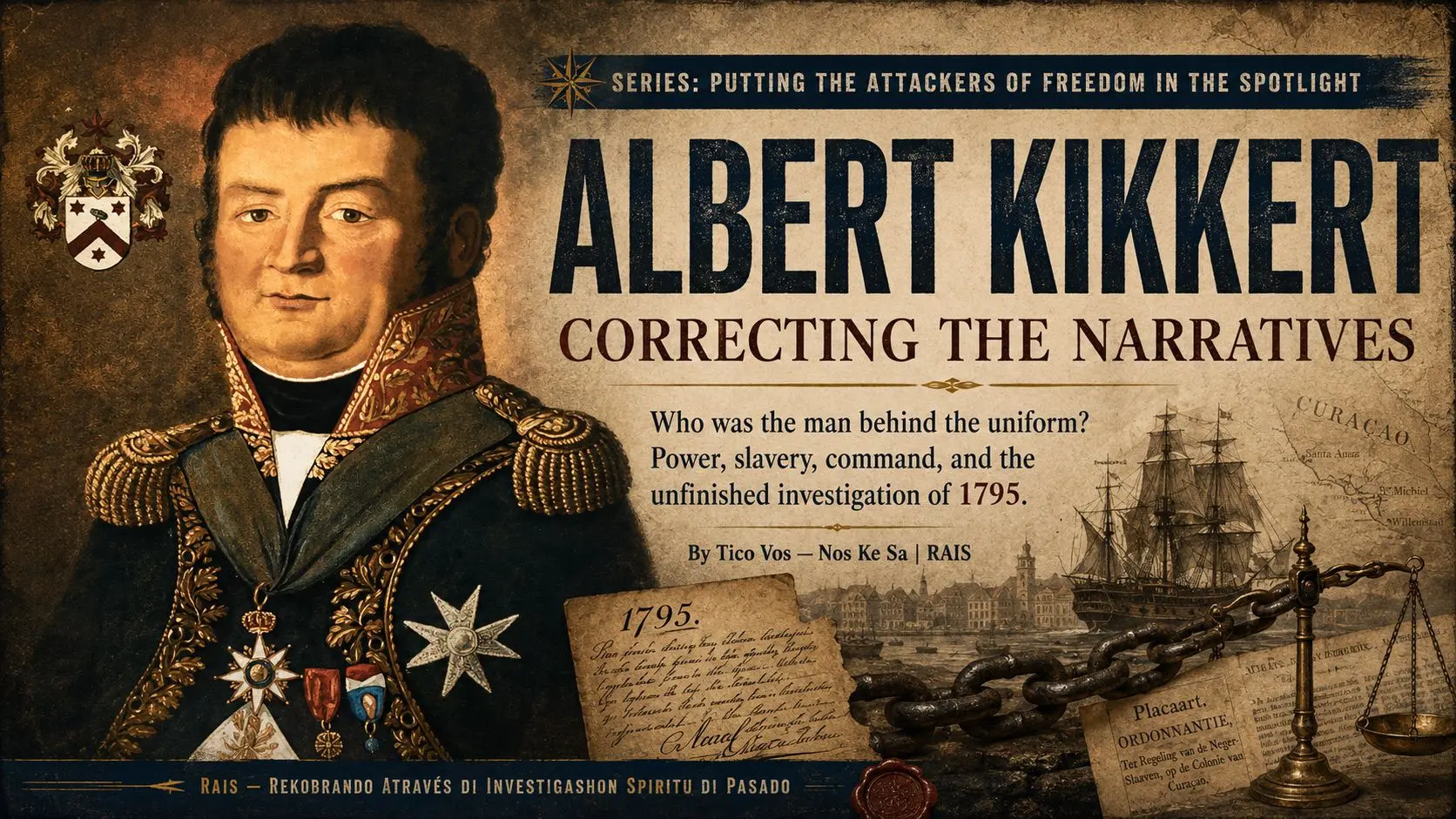
 What If We Discover the Monster Albert Kikkert Was in 1795?
Dare to Investigate
By Tico Vos — Nos Ke Sa | RAIS
Rekobrando através di investigashon nos spiritu di passado
When we look at the official portrait of Albert Kikkert, we see the image that history chose to preserve: a decorated uniform, medals, gold embroidery, military dignity and the authority of a man who would later become governor-general of Curaçao. That image tells us how power wanted to be remembered. It does not necessarily tell us who the man was. That is why RAIS begins before the uniform, before the medals and before the prestige. It asks a more difficult question: who was Albert Kikkert as a human being, and what did he do when his own interests, his authority and the freedom of others collided?
Kikkert was born on Vlieland in 1761 and was formed in the maritime and military world of the Dutch Republic. Ships, hierarchy, discipline, obedience, and war were part of the environment in which he learned to function.
He participated in the naval operations of the Fourth Anglo-Dutch War, including the Battle of Dogger Bank in 1781. None of this proves that he was naturally cruel, but it does help us understand the personality that later appears in the historical record: a man accustomed to command, capable of restoring order and apparently uneasy when his authority was challenged.
Curaçao changed his position fundamentally. In 1789, he married Anna Maria Cornelia van Uytrecht and, through that marriage, entered one of the island’s wealthy planter families. He became connected with plantations including San Juan and Pannekoek and therefore with a colonial economy built upon slavery. By the time the freedom struggle erupted in August 1795, Kikkert was no longer simply a Dutch naval officer stationed temporarily on the island. He had become part of Curaçao’s privileged colonial order, a plantation owner and a slaveholder.
That distinction becomes crucial when we examine his role in 1795. In February of that year, Kikkert took command of the Dutch frigate Ceres. The vessel was suffering from disease, desertion, debts, and disorder, and he succeeded in restoring discipline. This shows that he was effective and capable. But competence and morality are not the same thing. When enslaved people began their struggle for freedom on 17 August, the man commanding the Ceres was at the same time someone whose social and economic position was tied to the system they were resisting.
For generations, the historical narrative concentrated almost exclusively on the actions of Tula and the freedom fighters. What did they do? Who joined them? What did they take? What did they burn? Who carried weapons? Who refused an order? Who should be punished? But once Tula and the others are recognized as freedom fighters, those questions can no longer be the only ones we ask. The historical lens must turn around.
Who deprived these men and women of their freedom in the first place? Who profited from their forced labor?
Who ordered troops against them? Who commanded the warships? Who transported captured freedom fighters? Who authorized torture? Who decided that certain men should die? Who carried out those decisions? And who protected the system that made all of this possible?
That is where Albert Kikkert must be placed.
Our investigation also brings us close to Bazjan Karpata and Pedro Wacao, important figures in the 1795 struggle, whose histories appear to be connected to the plantation environment surrounding the Van Uytrecht family and Kikkert. Exactly what they experienced and what they knew still requires deeper archival reconstruction. But their connection raises an important question: what did men who knew that plantation system from within understand about the people who controlled it, and what could have convinced them that freedom was worth risking everything for?
The picture becomes more troubling when we move beyond 1795 and examine Kikkert’s later conduct. The book De gouverneurs van de Nederlandse Antillen sinds 1815, edited by Gert Oostindie, does not present a flawless statesman.
It refers to Kikkert’s “amoureuze escapades” in Curaçao and the Netherlands, some of which were linked to paternity and legal proceedings. His marriage later deteriorated, financial problems followed, and when he returned to Curaçao in 1816 as governor-general, the biography records that he refused to live in the same house as his wife. These details should not be turned into gossip, and we should not pretend to know the full circumstances of relationships that took place more than two centuries ago. But they do show that the respectable public image concealed a far more complicated private life.
His behavior toward other men also reveals something about his character. Kikkert was apparently sociable and enjoyed dinners, balls and festivities, yet a different side emerged when his authority was challenged. In 1817, a dispute with Major W. Schmidt, acting commander of the garrison, reportedly escalated into insults, threats and Kikkert physically kicking the officer. Other officers protested. His biography notes that refinement in language and manners was not his strongest quality and that he could bellow as though he were still commanding a warship. That description matters because character is often revealed most clearly when power is questioned.
The most serious evidence, however, concerns Kikkert’s position toward slavery and free Black people. During his governorship, the Catholic priest Jacobus Stöppel criticized the treatment of enslaved people. Kikkert did not distance himself from the planter establishment. According to the biography, his attitude toward slavery did not differ from that of the planters and other wealthy citizens who, like him, were slave owners. He even considered removing Stöppel from the colony.
Even more disturbing is the proposal to send approximately 2,000 free Black inhabitants to Suriname because planters considered them troublesome. The Dutch minister rejected the proposal, but the fact that such an idea could be seriously considered is itself revealing. These were not enslaved people. They were free inhabitants. When their interests collided with those of powerful plantation owners, Kikkert appears to have aligned himself with the planter class.
That is where the word “monster” becomes provocative but must also be handled carefully. We should not begin by declaring Albert Kikkert a monster. That would replace investigation with accusation. But we should dare to ask whether the archival record might eventually reveal conduct so morally disturbing that the respectable portrait can no longer be accepted without serious qualification.
The danger is that we imagine a monster as someone who must look monstrous. History often shows something different. Sometimes brutality appears in ordinary administrative decisions: a military order, a prisoner transfer, a plantation inventory, a deportation proposal, a punishment authorization, a sentence, a logbook entry or a signature. A person may dine politely, attend religious institutions, wear medals and hold office while at the same time participating in a system that denies another human being freedom.
Religion makes this contradiction even sharper. Kikkert was identified as Reformed and was also associated with Freemasonry. Christianity and a tradition of brotherhood therefore existed alongside slave ownership. How did he reconcile those worlds? We do not yet know. His letters, church records, lodge documents and personal correspondence need to be examined. But the contradiction is historically important enough to investigate.
The contrast becomes even more striking when Kikkert is placed beside Tula. According to Father Jacobus Schinck’s report, Tula referred in 1795 to Adam and Eve and to the common origin of humanity. The man deprived of freedom appealed to the idea of one human family, while the colonial order that claimed Christianity continued to defend slavery. That does not tell us exactly what Kikkert personally believed about Scripture, but it raises an important moral question: who in that confrontation was appealing more directly to the principle of common humanity?
Kikkert’s political adaptability also deserves closer scrutiny. He lived through the Batavian Republic, the Kingdom of Holland, the French Empire and later the restored Dutch monarchy under Willem I. In 1796 he participated in a pro-French military committee, while later he could condemn French tyranny and serve the restored monarchy. Was this pragmatism, military obedience, political survival, careerism, or changing conviction? The evidence is not yet sufficient to determine the answer, but the pattern shows a man who knew how to remain useful as regimes changed.
Then there is the famous story about Curaçao’s colorful houses. Here we can clearly distinguish between a documented fact and a story that still requires proof. On 28 April 1817, Kikkert issued a regulation prohibiting the whitewashing of houses and other buildings in Willemstad, Otrobanda, Pietermaai and Scharloo. The official explanation was that the reflection of the intense Caribbean sunlight from white walls was harmful to the eyes. Owners were therefore required to use another color. That order existed; this part is not legend.
The second part of the story is more provocative. For generations, Curaçaoans, tour guides and tourism publications have repeated that Kikkert suffered from headaches or eye problems and that he supposedly had shares or another financial interest in the island’s paint business, perhaps even its main or only supplier. That allegation has become part of the popular explanation of “Colorful Curaçao”. But this is precisely where RAIS must insist on the document. Was Kikkert really a shareholder? Who owned the paint business in 1817? Did his wife or the Van Uytrecht family have a financial interest? Did a government order create private profit for someone close to the governor?
If archival research proves such a connection, the colorful-house story would acquire a very different meaning. It would no longer be only picturesque tourism history; it could become a model of public authority intersecting with private financial interests. Until those shareholder, commercial or notarial records are found, however, the documented decree must remain separate from the still-unproven allegation of personal profit.
The later history of Jan Sofat also belongs in this reconstruction. Spanish Water Resort N.V. became the real-estate developer of Jan Sofat, and Arturo “Tula” Jessurun was closely associated with that development. My own research and audiovisual documentation of the later Albert Kikkert monument project, including sculptor Elly Baltus, Jessurun, descendants and questions surrounding historic property, form part of the modern evidentiary trail. But exact corporate positions and shareholdings must still be established through notarial and company records before they are published as fact.
That discipline is essential. If we want to correct an incomplete colonial history, we cannot replace it with an insufficiently sourced narrative.
The Dutch decision of 3 October 2023 to rehabilitate Tula and other participants in the 1795 struggle as freedom fighters was historic, but it should be understood as a comma, not a full stop. Their status was corrected, but the larger historical ecosystem around them was not. Now the people and institutions that defended the system from which they were trying to become free must also be investigated.
This is not about manufacturing villains or seeking revenge against the dead. It is about identifying responsibility and giving the living a more honest account of the past. We need the complete Ceres logbooks, Kikkert’s military orders and correspondence, plantation inventories from San Juan and Pannekoek, documentation concerning Karpata and Wacao, records of prisoners transported after the fighting, the Stöppel papers, the proposal involving approximately 2,000 free Black inhabitants, church and Freemasonry records, paternity files, family correspondence, commercial records behind the paint story, and the later corporate and property documents surrounding Jan Sofat and the Kikkert monument.
Most of all, we need to reconstruct the chain of responsibility in 1795. Who gave the orders? Who knew? Who objected? Who remained silent? Who transported the prisoners? Who authorized torture? Who decided on execution? Who carried it out? Who benefited when the freedom fighters were defeated?
Only then will we begin to know the Albert Kikkert of 1795.
Perhaps what we discover will be more complex than the word “monster”. We may find courage beside cruelty, competence beside moral blindness, sociability beside authoritarianism, religion beside slavery and public service beside private interest. But that complexity may be more disturbing than a simple label, because history’s monsters do not always arrive looking like monsters. Sometimes they arrive in uniform, with medals, legal authority, respectable friends, religious affiliations and a portrait painted for posterity.
The question, therefore, is not whether we should condemn Albert Kikkert before opening the archives. The question is whether we dare to open them completely.
What if we discover the monster Albert Kikkert was in 1795?
Then we must have the courage to write it. And if the evidence shows something different, we must have the same courage to correct ourselves.
That is RAIS: Rekobrando Através di Investigashon Nos Spiritu di Pasado.
Nos Ke Sa — to know, we must dare to investigate.