17 August 1795 Curaçao’s Struggle to Recover Freedom
The events that began on Curaçao on 17 August 1795 are often introduced as the “Curaçao Slave Revolt of 1795.” That terminology describes the legal status imposed upon the people involved and the resistance that followed, but it can also reproduce the viewpoint of the colonial authorities against whom they acted.
A different starting point changes the historical picture.
The people who gathered at plantation Knip/Kenepa that Monday morning were human beings whose liberty had been taken from them. They lived within a colonial system in which people could be treated as property, compelled to work, separated from family, punished and transferred without enjoying the freedom to determine the course of their own lives.
From that perspective, 17 August can be understood not simply as the beginning of a “slave revolt,” but as an organized attempt by people held in slavery to recover a freedom that preceded their enslavement.
For those approaching the history through a Biblical or natural-rights understanding of humanity, that freedom can also be described as God-given: no person is born naturally belonging to another person. Tula himself reportedly invoked the Biblical account of humanity descending from Adam and Eve when discussing the injustice of the social order. His argument placed human equality above the racial and legal categories constructed by colonial society.
17 August: refusing forced labor and property status
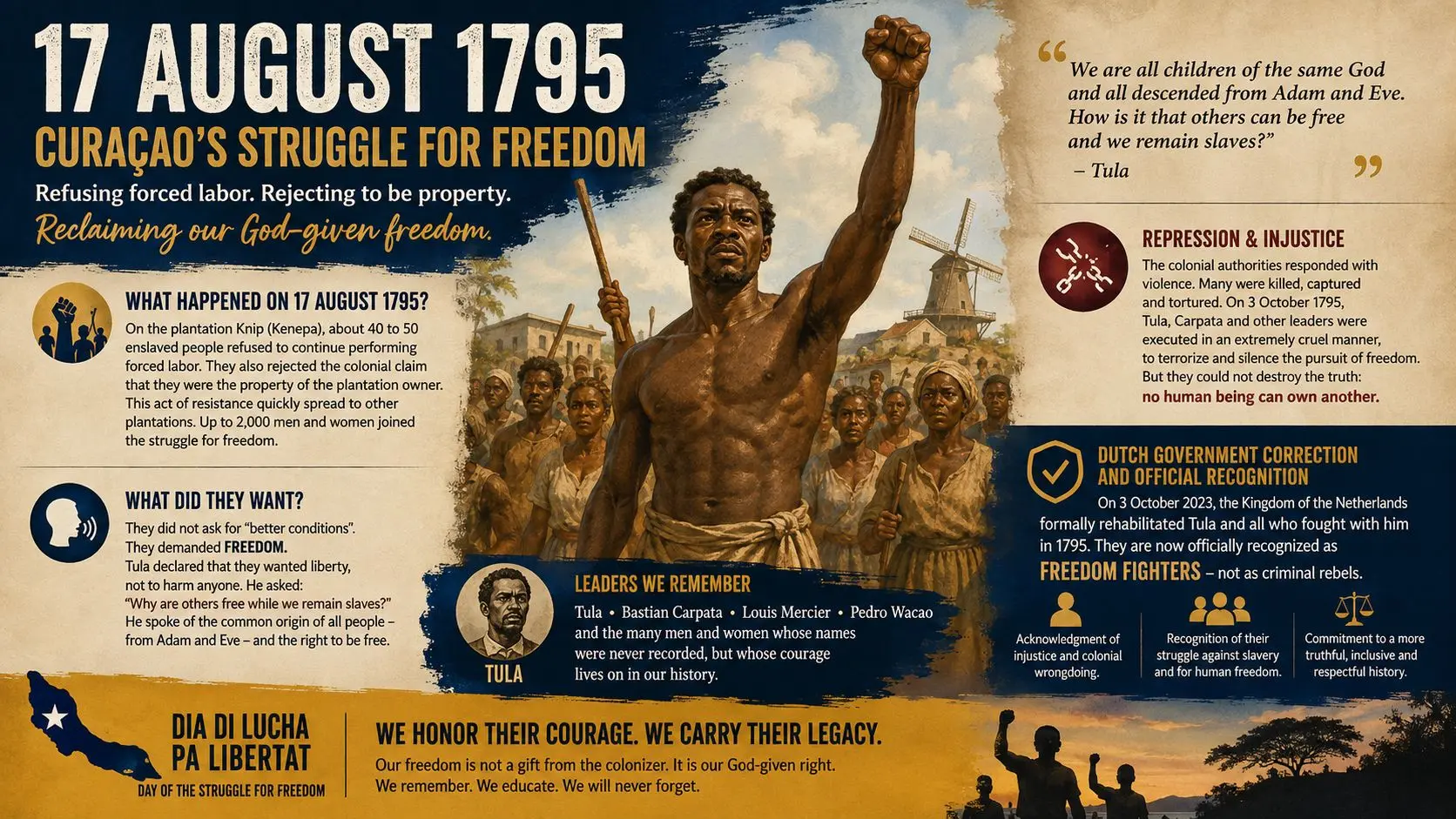
On the morning of 17 August 1795, approximately forty to fifty people at Knip, the plantation of Casper Lodewijk van Uytrecht, refused to continue performing forced labor.
But their action went beyond a work stoppage.
They were also rejecting the colonial claim that they were the plantation owner's property.
That distinction is essential.
The issue was not simply that workers demanded different conditions. These were human beings legally classified as property and compelled to labor for others. By refusing forced labor, they challenged both the plantation’s economic system and the presumed right of one human being to own another.
Rather than beginning the history by asking why enslaved people “rebelled,” a more fundamental historical question is:
Why were human beings being forced to work for people who claimed ownership over them in the first place?
Resistance was not the original act of coercion.
Enslavement was.
Tula emerged as one of the principal leaders. The movement expanded beyond Knip as people from other plantations joined. Among the principal figures remembered alongside him are Bastian Carpata, Louis Mercier and Pedro Wacao.
These men and the many others who participated should not be understood merely as followers in an uncontrolled disturbance. Their actions required communication, movement between plantations, persuasion, organization and decisions involving considerable personal risk.
What did they want?
One persistent problem in descriptions of 1795 is the suggestion that the participants were seeking a mixture of emancipation and “better working conditions.”
The surviving evidence requires a clearer distinction.
During the confrontation at Porto Marie on 19 August, Catholic priest Jacobus Schinck spoke with Tula in an attempt to persuade the group to end its action. According to Schinck’s surviving report, Tula explained that they did not seek to harm anyone but sought their freedom.
Tula certainly spoke about mistreatment. But protesting mistreatment while remaining enslaved is fundamentally different from demanding an end to the condition of enslavement itself.
His reasoning went deeper.
He questioned why people elsewhere could obtain freedom while Curaçao’s enslaved population remained unfree. He referred to political changes involving France, the Netherlands, and the French Caribbean. He also appealed to humanity's common origin through Adam and Eve.
These arguments reveal someone who is thinking about freedom, legitimacy, equality, political change, and human dignity.
International events: context, not ownership of the idea of freedom
The French Revolution, the abolition of slavery by revolutionary France, and events in Saint-Domingue formed part of the political world known to Tula and his contemporaries.
But awareness should not automatically be transformed into causation.
To say that the struggle was simply “inspired by the Haitian Revolution” risks suggesting that enslaved Curaçaoans required outsiders to teach them that they wanted to be free.
Freedom need not be imported for an unfree person to desire it.
News from Saint-Domingue, France, and the changing Dutch political order could have provided evidence, encouragement, and political arguments. They demonstrated that systems once presented as permanent could change.
But the fundamental reason for resistance existed on Curaçao itself:
human beings were being denied control over their own lives, compelled to labor, and legally treated as the property of others.
International revolutions therefore belong in the context of 1795, but they should not replace the agency, experiences and reasoning of Curaçao’s freedom fighters.
From resistance to colonial repression
The colonial authorities did not recognize the participants as people legitimately asserting a right to freedom. They regarded the movement as a threat to property, public order and colonial authority.
Military force followed.
The struggle continued for weeks. People were killed, wounded, captured and pursued. Tula and other leaders were eventually taken prisoner.
What happened afterward is essential to understanding 1795.
Once captured, these men were no longer active combatants confronting colonial troops. They were prisoners under the complete control of the colonial government.
Interrogations involved torture. Colonial proceedings produced confessions and accusations that historians must therefore read with extreme caution.
On 3 October 1795, Tula, Carpata and other principal participants were subjected to exceptionally cruel executions intended not merely to kill them but to terrorize others against attempting similar resistance.
Their bodies were denied ordinary human dignity even after death.
Reading a colonial archive differently
Much of what is known about 1795 survives because colonial administrators, military officers, judicial officials and clergy recorded events.
That creates a historical problem.
The people exercising power produced most of the documents through which the people resisting that power are remembered.
Terms such as “rebel,” “insurgent,” “criminal” and even “slave” therefore require context. They may describe colonial classifications, but they should not automatically determine modern historical interpretation.
Modern archival institutions themselves now acknowledge that colonial records are incomplete and often reflect a one-sided colonial perspective.
That means historians have to read these sources critically: not only asking what the authorities recorded, but also what the documents reveal unintentionally about the people who resisted them.
The Dutch government’s correction: freedom fighters, not criminals
A major correction to the historical narrative was issued by the Dutch government on 3 October 2023.
On that date, the Kingdom formally rehabilitated Tula and recognized him as a freedom fighter rather than as a criminal rebel.
Importantly, the correction was not limited to Tula alone.
The Dutch government’s recognition concerned Tula and the others who fought alongside him for freedom in 1795. They are now officially acknowledged within the framework of a struggle against slavery and for liberty.
This changes the language that should be used when describing the events.
If those who participated were freedom fighters, then their actions cannot continue to be presented exclusively through the terminology of the colonial government that prosecuted them.
Calling them freedom fighters does not mean that every action committed during the conflict becomes beyond historical examination. It means that the central purpose of their struggle is now recognized differently: they were resisting a system that deprived human beings of liberty and treated them as property.
That official rehabilitation also raises a broader historical question.
If Tula and his companions are now recognized as freedom fighters, historians must examine not only what the freedom fighters did, but also the conduct of those who attempted to suppress them.
That includes the decisions of plantation owners, colonial administrators, judicial officials, military officers and others who defended the system of forced labor and human ownership.
The historical lens therefore has to widen.
17 August reconsidered
The history of 17 August 1795 begins before the first refusal to work.
It begins with the removal of human freedom.
Tula, Carpata, Mercier, Wacao, and the many women and men whose names have not survived in the written archive did not become human beings seeking dignity because a revolution occurred elsewhere.
They already possessed humanity.
They already understood coercion.
They already understood the difference between being compelled to work and choosing one’s own labor.
And they understood what it meant to be legally treated as another person’s property.
What changed on 17 August was that a group of them collectively decided that they would no longer accept those conditions.
They refused to continue performing forced labor.
They rejected the claim that they belonged to the plantation owner.
They demanded freedom.
Their struggle was eventually defeated militarily.
Their central argument was not.
A colonial system could declare a human being property.
It could compel that person to work.
It could punish resistance.
It could torture prisoners and execute leaders.
But it could not transform ownership of another human being into a natural or morally legitimate condition.
Seen from that perspective, 17 August 1795 was not simply the day enslaved people revolted against Curaçao’s established order.
It was the day human beings collectively challenged forced labor, rejected their imposed status as property, and attempted to recover the freedom that had been taken from them.
The Dutch government’s rehabilitation of Tula and his fellow freedom fighters in 2023 confirms that this history can no longer responsibly be told only through the vocabulary of those who suppressed them.
They were not simply rebels against authority.
They were freedom fighters confronting a system that denied them freedom.