
Albert Kikkert, The Ceres, And The Prisoners Who Did Not All Arrive Alive
What the naval record forces Curaçao to investigate about prisoner transport, hangings at sea, and command responsibility in 1795.
By Tico Vos, Nos Ke Sa
For generations, we were told in extraordinary detail what happened to Tula after he was captured. We learned about his interrogation, judicial torture, sentence, and execution. But another part of the story received far less attention: what happened to the men captured with him and to the other freedom fighters transported toward Willemstad under Dutch military and naval control?
The surviving evidence raises an uncomfortable question: did every captured freedom fighter placed in colonial custody arrive alive at Fort Amsterdam? The naval records indicate that the answer is no. One of the most important witnesses is not Tula, Pater Jacobus Schinck, or an oral tradition passed down through Curaçaoan families. It is the documentation connected to Captain Albert Kikkert and the Dutch warship Ceres.
THE CERES WAS NOT A PASSIVE OBSERVER
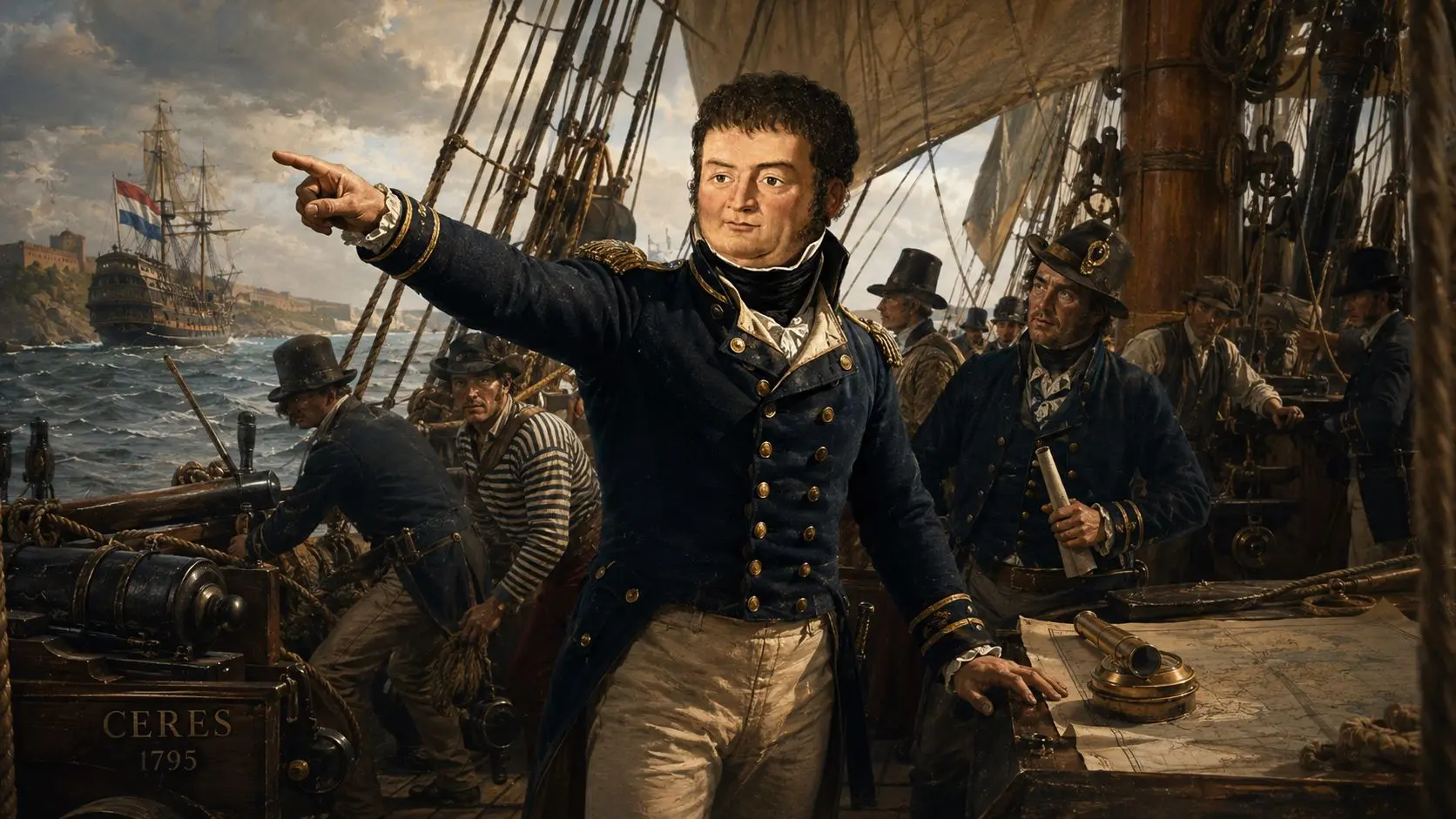
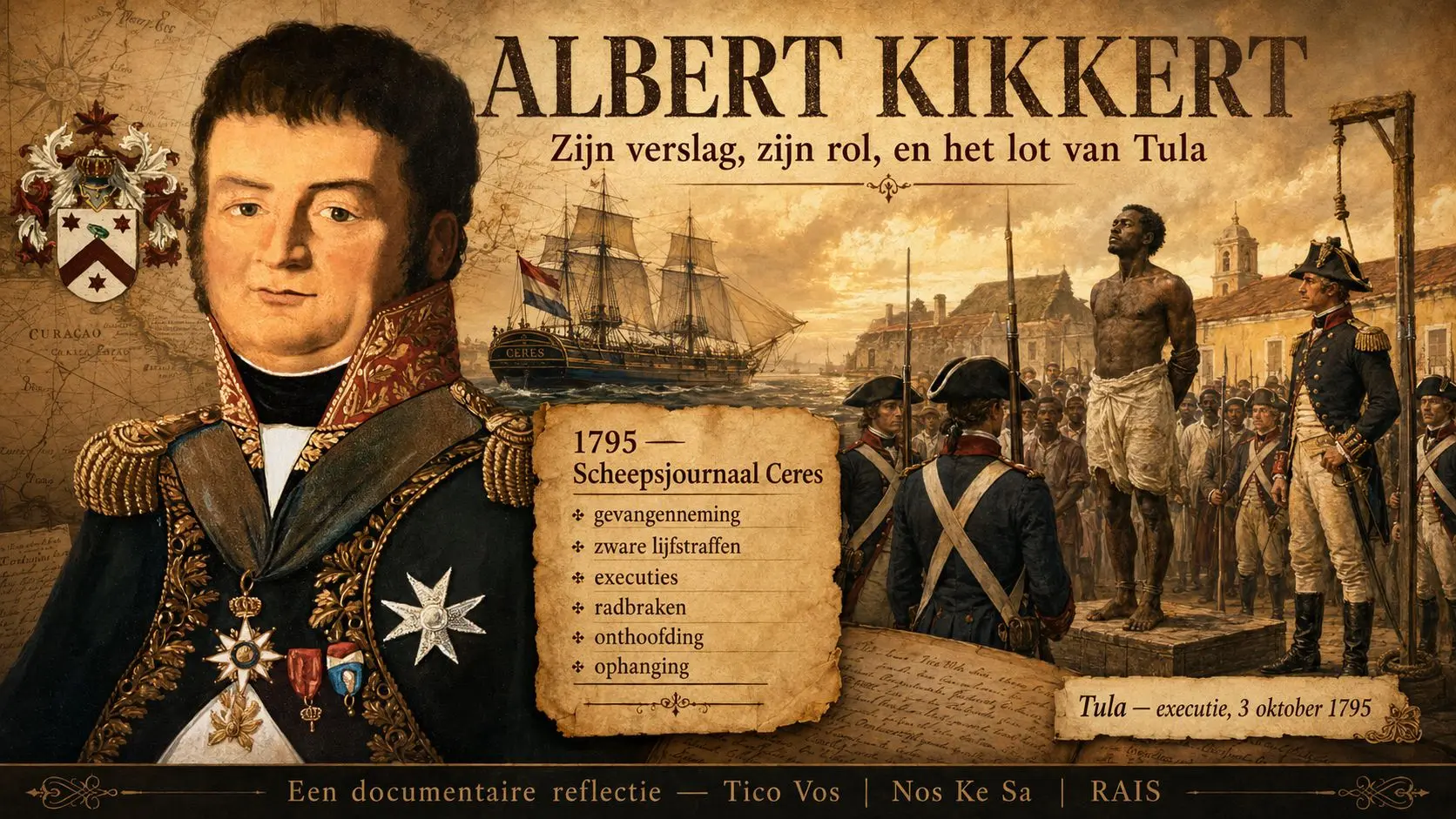
Albert Kikkert commanded the Ceres during the freedom struggle that began on 17 August 1795. Historical research describes the Ceres as a heavily armed Dutch frigate of approximately 860 tons and 40 guns.
The Medea, commanded by F.J. Wierts, was also stationed at Willemstad. These warships were not passive observers. Research based on the surviving naval journals shows that they provided gunpowder, personnel, and military assistance during the colonial campaign against the freedom fighters. Marines participated in the suppression. Kikkert had even ordered the cannons of the Ceres loaded with live ammunition and grapeshot as colonial fear of resistance increased.
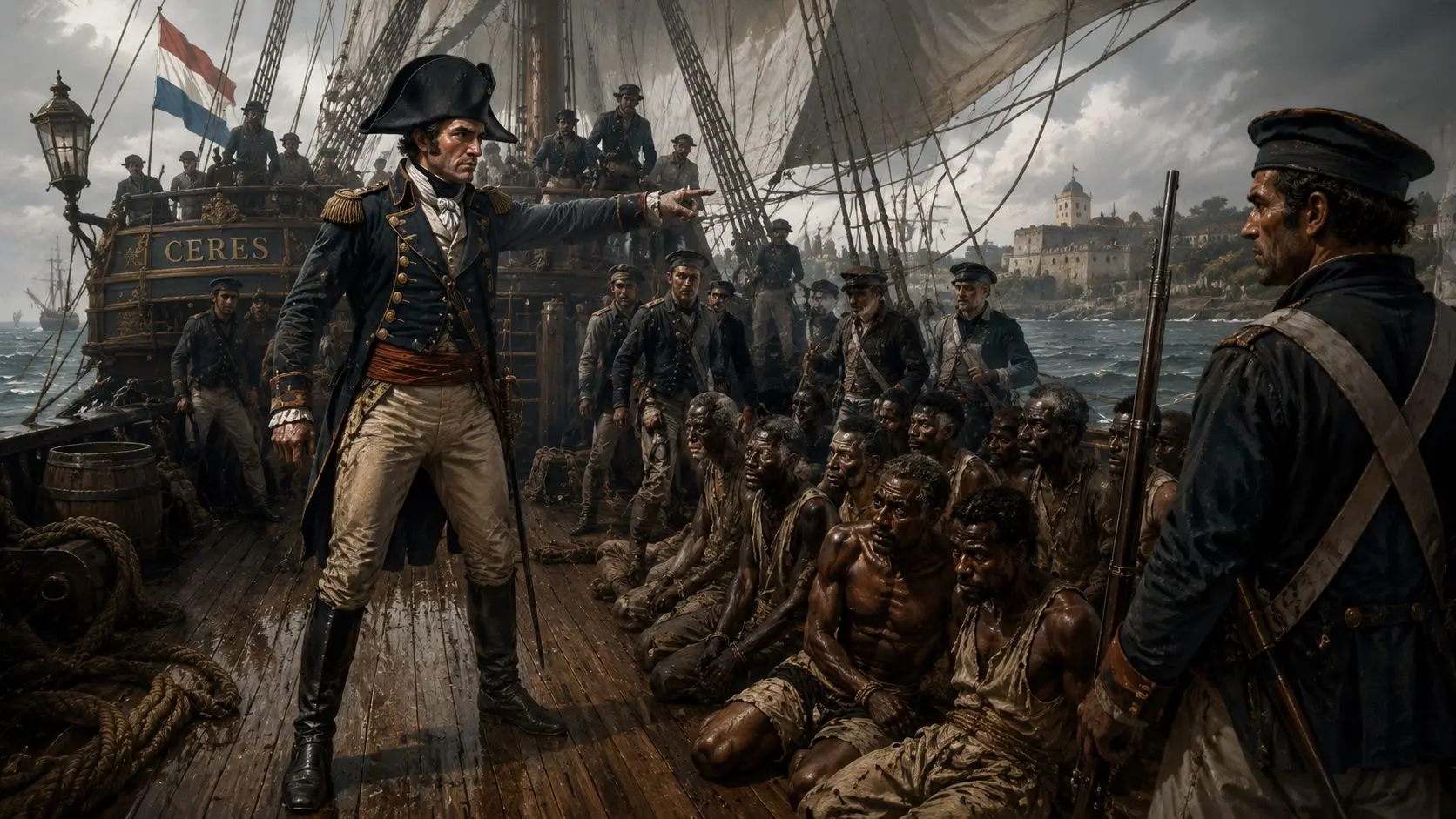
Kikkert also had a personal connection to the plantation society the military forces were defending. Through his marriage to Anna Maria Cornelia van Uytrecht, he became connected to one of Curaçao’s influential plantation-owning families. This does not prove that Kikkert personally ordered the reported hangings, but it matters when examining his position, interests, and responsibilities. We should stop looking at Kikkert exclusively through the comfortable historical portrait of a naval officer, later governor-general and prominent colonial administrator. In August and September 1795, he commanded one of the principal military instruments used by the colonial state to defeat men and women attempting to regain their God-given freedom.
As colonial troops captured increasing numbers of freedom fighters, the Ceres was transformed into a detention facility.
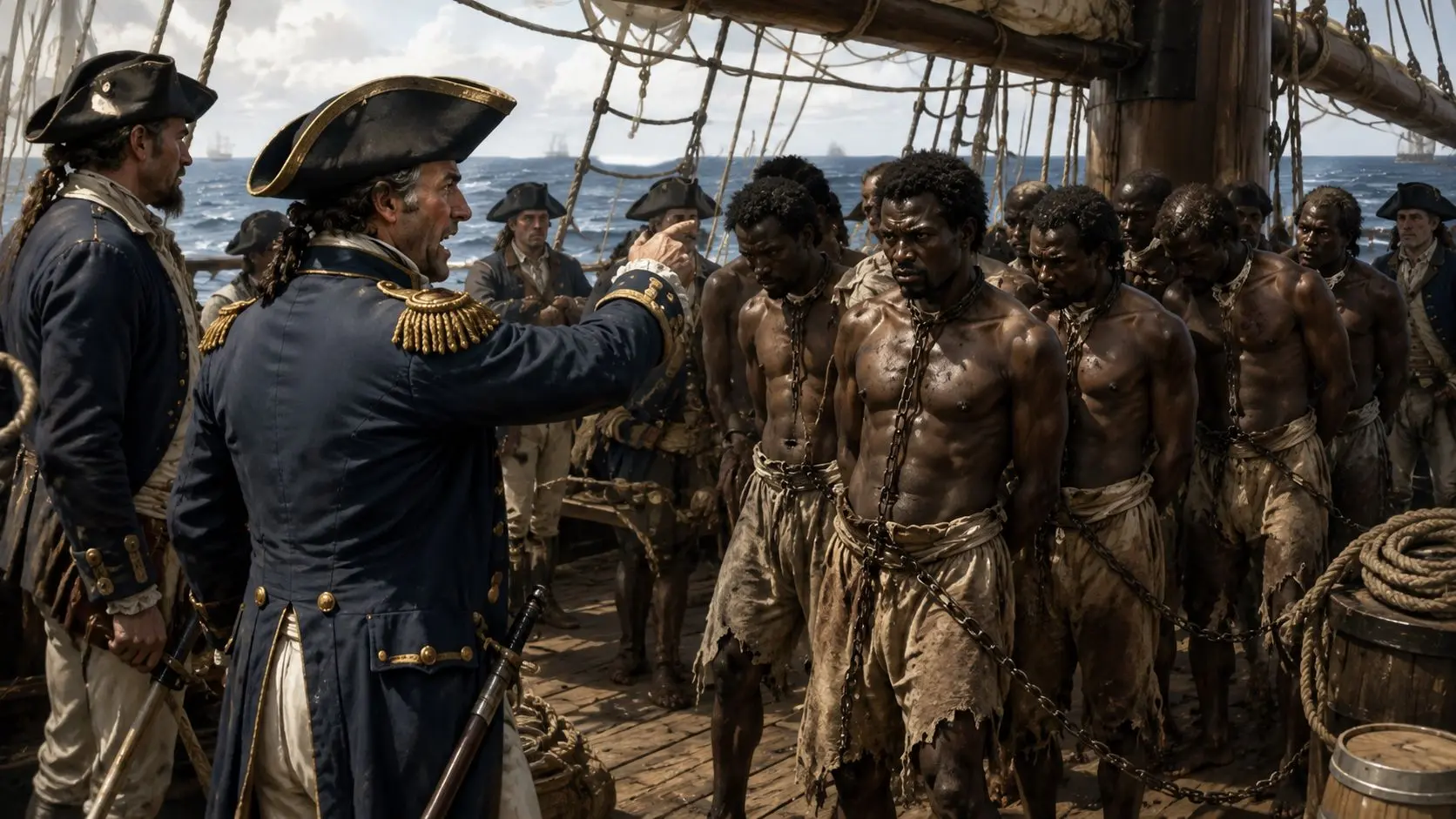
The warship became a floating prison. Historical research based on Kikkert’s journal records that, at one point, at least eighty suspected participants were detained aboard the Ceres. They remained under armed naval custody until prosecutor P. Th. van Teylingen ordered that prisoners be brought ashore for interrogation. These men were no longer fighting. They had been captured, restrained and placed under the control of the colonial authorities. From that moment, responsibility for their lives passed to those who detained, guarded, transported and interrogated them.
Who registered their names? Who counted them? Who guarded them? Who authorized their removal from one vessel to another? Who recorded whether they arrived alive? Who was responsible when they did not? The colonial archive devoted great attention to accusations, interrogations, punishments and executions. But did it preserve an equally precise account of every prisoner placed in the hands of the military and navy? That question becomes urgent when we read what the Ceres journal reportedly records.
2 SEPTEMBER 1795: A BODY ENTERS THE HARBOR
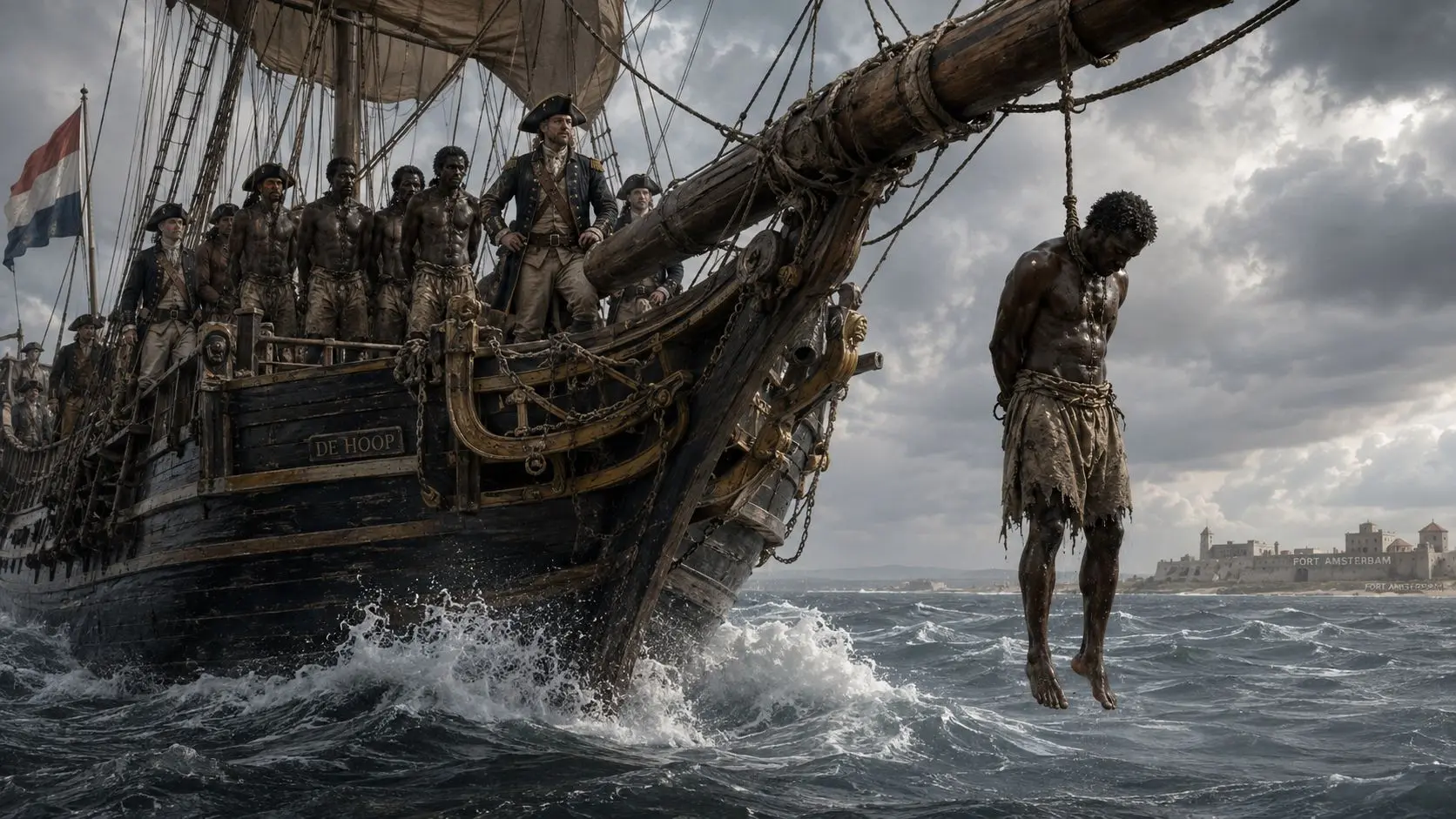
The entry for 2 September 1795 deserves particular attention. Published historical research citing the Ceres journal reports that a naval sloop entered Willemstad carrying prisoners. But the vessel carried something else. A man was hanging from its bowsprit. According to the published reconstruction, the body was cut down as the vessel entered the harbor.
This was not simply a body discovered on a battlefield several days after combat.
A vessel participating in the colonial naval operation entered Willemstad carrying captured people while a dead man remained visibly suspended from it. Who was he? Where had he been captured? Was he alive when he was placed aboard? Was he interrogated? Was he accused of attempting to escape? Who ordered his hanging?
Who carried it out? Was any form of trial held? Was a sentence pronounced? Was the killing reported to the prosecutor or the colonial council? Was his death entered into an official register? Did Albert Kikkert receive a report explaining what had happened?
Most importantly, where is this man’s name? History cannot state that an unidentified man was hanging from a bowsprit and then continue to the next event. That man had a life and an identity. He may have had parents, a wife, children, relatives and companions. He was one of the human beings resisting a system that had reduced people to property. He deserves to be recovered from the anonymity imposed upon him by the colonial record.
19 SEPTEMBER: MORE PRISONERS REPORTED HANGED
The evidence becomes even more disturbing on 19 September 1795. Published research citing the Ceres journal states that a barque under Lieutenant De Lange returned with additional prisoners. The journal reportedly records that three prisoners had been hanged aboard the vessel. The same research mentions another man hanged aboard a sloop before it returned to port. We have now moved beyond a single unexplained death. The record describes several hangings connected with vessels transporting captured people. This creates a historical problem Curaçao cannot responsibly ignore.
Were these executions? If so, under whose authority were they conducted? Had sentences been imposed by a legally constituted court? Were the prisoners accused of attempting to escape? Did officers claim emergency powers? Were they killed as punishment or intimidation? Were naval officers exercising summary authority over captured freedom fighters? Were these deaths subsequently entered into judicial or military registers? Or did men disappear between their capture in Bandabou and the arrival of the vessels in Willemstad without ever being formally registered as prisoners or executed persons?
We should not claim that Kikkert personally ordered every hanging when the available evidence has not established that. These deaths must be described cautiously as reported hangings while researchers investigate whether they constituted extrajudicial executions. But historical caution cannot become an excuse for historical silence.
The date 19 September becomes even more significant because the naval journals also provide information about Tula’s arrival in Willemstad. According to published reporting on the archival material, Tula was brought into Willemstad on horseback and displayed for approximately one hour on the Otrobanda side of the harbor.
He was then taken across the harbor by ferry, reportedly accompanied by drumbeats, and transported along the city wall toward Fort Amsterdam. This was not merely transportation. It appears to have been a public display of colonial control. Tula, the man who challenged the legitimacy of enslavement, was presented as a defeated captive before being taken into the machinery of interrogation, torture, judgment and execution.
The journals of the Ceres and Medea give us an opportunity to reconstruct the entire chain of custody: capture, transportation, arrival, detention, transfer, interrogation, torture, trial and execution. But that chain must not be reconstructed only for Tula. It must be reconstructed for every captured freedom fighter whose identity can still be recovered.
WHAT DID ALBERT KIKKERT KNOW?
The question is not merely whether Kikkert personally tied a rope around someone’s neck. That would be far too narrow. Kikkert commanded the Ceres. His journal recorded the movements of vessels, personnel and prisoners. Captured freedom fighters were imprisoned aboard his warship. Naval personnel served within the military operation. Smaller vessels transporting prisoners operated within the wider structure of colonial and naval command.
What happened under Kikkert’s command? Which vessels were attached to the Ceres? Who issued instructions to Lieutenant De Lange? Who commanded the sloop that entered with a body hanging from its bowsprit? Who authorized the transportation of prisoners? What orders had been issued concerning escape, resistance, or refusal to cooperate? Who possessed the legal authority to pronounce a death sentence? Were prisoners counted when they were received and again when they arrived? Did Kikkert ask why prisoners were missing? Did he investigate when vessels arrived carrying dead men?
Did he report the hangings to Captain Wierts, Governor Johannes de Veer, the colonial council, or prosecutor Van Teylingen?
If he reported them, where are those reports? If he did not report them, why not? If colonial authorities knew about these deaths, why was no investigation conducted? If an investigation was conducted, where are its findings?
These are questions of command responsibility. Command responsibility does not automatically mean that the commander personally ordered every act. It requires an investigation into what the commander knew, what he should have known, what authority he exercised, and what action he took after learning that prisoners had died.
The historical trail has not disappeared completely. The Nationaal Archief identifies the surviving journal of Captain Albert Kikkert, commander of the Batavian frigate Ceres. It covers the period from 18 February 1795 until 3 July 1799 and is listed as inventory number 73 in archive 2.01.29.03. We therefore possess a contemporaneous record written from inside the naval command structure.
That journal must be completely transcribed for the crucial period from August through October 1795. Every reference to prisoners, sloops, barks, marines, officers, alarms, transfers, deaths and executions should be identified and compared with other documents. The Ceres journal must be placed beside the Medea journal, minutes of the colonial council, military correspondence, reports from Governor Johannes de Veer, documents written by prosecutor Van Teylingen, interrogation records, judicial sentences and execution registers. The archive must be made to answer itself.
One document may record how many prisoners departed. Another may record how many arrived. A third may identify the commanding officer. A fourth may reveal that a person was never interrogated because he was already dead. Only by connecting these records can we reconstruct what happened between capture and Fort Amsterdam.
THE CERES WAS PART OF THE EXECUTION APPARATUS
The role of the Ceres did not end with military supplies or prisoner detention. Research based on its journal indicates that when executions took place in Willemstad, an alarm was sounded aboard the ship and members of its crew were sent ashore to provide security. The Ceres therefore appears at several stages of the colonial machinery of repression: military preparation, ammunition supply, personnel deployment, prisoner detention, transportation connected with the naval operation and security surrounding executions.
That is very different from portraying the Ceres as a Dutch ship anchored peacefully in Willemstad while colonial authorities dealt with a resistance movement on land. The ship was part of the story. Its personnel were part of the story. Its smaller vessels were part of the story. Its journal is part of the evidence.
Its captain must therefore be part of the investigation.
On 3 October 1795, Tula, Bastiaan Carpata and Pedro Wacao were subjected to exceptionally brutal public executions. Their bodies were not merely killed. They were deliberately mutilated and destroyed as a warning to the rest of the enslaved population. Kikkert recorded the executions in his journal. Published accounts of the entry describe him recording the breaking on the wheel, burning, beheading, mutilation, and hanging imposed upon the three freedom fighters.
This entry matters because Kikkert was not writing two centuries later. He was present in Curaçao. He commanded a warship involved in the suppression. His journal was produced from within the same colonial apparatus that captured, detained, tortured, and executed the freedom fighters. It is not a distant recollection. It is contemporaneous evidence.
But we should ask more than what Kikkert recorded. How did he describe these men? Did he record their words? Did he question the legality of what was done? Did he express concern about the hangings aboard the vessels? Or did he document the destruction of human lives as a normal part of colonial administration? Silence in a journal is not by itself proof of personal guilt. But when the writer commands the ship being used as a prison, silence about unexplained prisoner deaths becomes historically significant.
WHERE ARE THEIR NAMES?
Curaçao now needs a complete database of everyone known to have participated in the 1795 freedom struggle. For every identified person, researchers should establish where and when the person was captured, who captured him or her, to whom the prisoner was transferred, whether the person was transported over land or by sea, which vessel was used, who commanded it, how many prisoners departed, how many arrived, whether the prisoner was held aboard the Ceres, whether the person was transferred to Fort Amsterdam, interrogated, tortured, sentenced, released, executed, returned to forced labor or never accounted for.
The numbers must then be compared. If twenty prisoners departed and only seventeen arrived, what happened to the missing three? If the journal records three hangings aboard a bark, can those deaths be connected to names found in capture reports? If a man entered Willemstad hanging from a bowsprit, was his name omitted because the colonial administration never intended to recognize his individual humanity? If another man was hanged aboard a sloop, where had he been captured, who guarded him, and who decided that he would not reach Fort Amsterdam alive? This is no longer merely a debate about terminology. It is forensic historical reconstruction.
On 3 October 2023, the Dutch government formally rehabilitated Tula and recognized the others who participated in the 1795 resistance as people who fought for freedom and justice. That decision changed the historical question. We cannot rehabilitate the freedom fighters while continuing to investigate only what colonial authorities accused them of doing. We must also investigate what the colonial authorities did to them.
Who attacked their struggle for freedom? Who provided the weapons? Who commanded the troops and warships? Who captured them? Who transported them? Who tortured them? Who pronounced the sentences? Who supervised the executions? Who protected the enslavers’ property while human beings were denied ownership of their own bodies? Who died in battle? Who died after capture? Who entered Willemstad alive? Who arrived dead? Who never arrived at all?
The rehabilitation of Tula cannot be the final sentence of the investigation. It must be the beginning of a new examination of the people and institutions that defended enslavement.
Somewhere between Bandabou and Fort Amsterdam, men may have disappeared from the official story. The Ceres journal has left us disturbing clues: one man hanging from the bowsprit of a vessel entering Willemstad, three prisoners reportedly hanged aboard a bark, and another man reportedly hanged aboard a sloop. At least five deaths demand investigation. But do not reduce them to five. Each was a person. Each had a name. Each had a history before a colonial officer wrote a few words about his death.
Who were they? Where were they captured? Who placed them aboard those vessels? Who had custody of them? Who decided they would die before reaching Fort Amsterdam? Who carried out the hangings? Were their bodies returned to their families? Were they buried or thrown into the sea? Were their deaths concealed, normalized, or considered unimportant because the victims were legally classified as enslaved property? Where are the orders? Where are the reports? Where are their names?
After 231 years, Curaçao must no longer allow these men to remain hanging anonymously between the lines of a Dutch naval journal. Bring them down from the bowsprit of colonial history. Give them back their humanity. Give them back their identities. Give them back their names.
Nos Ke Sa. We want to know.
Tico Vos
Nos Ke Sa | RAIS