Jean-Baptiste Tierce Cadet: Why Was He Left Between The Dots?
Tula was rehabilitated. But was the story of Curaçao’s freedom fighters ever rehabilitated?
By Tico Vos | Nos Ke Sa
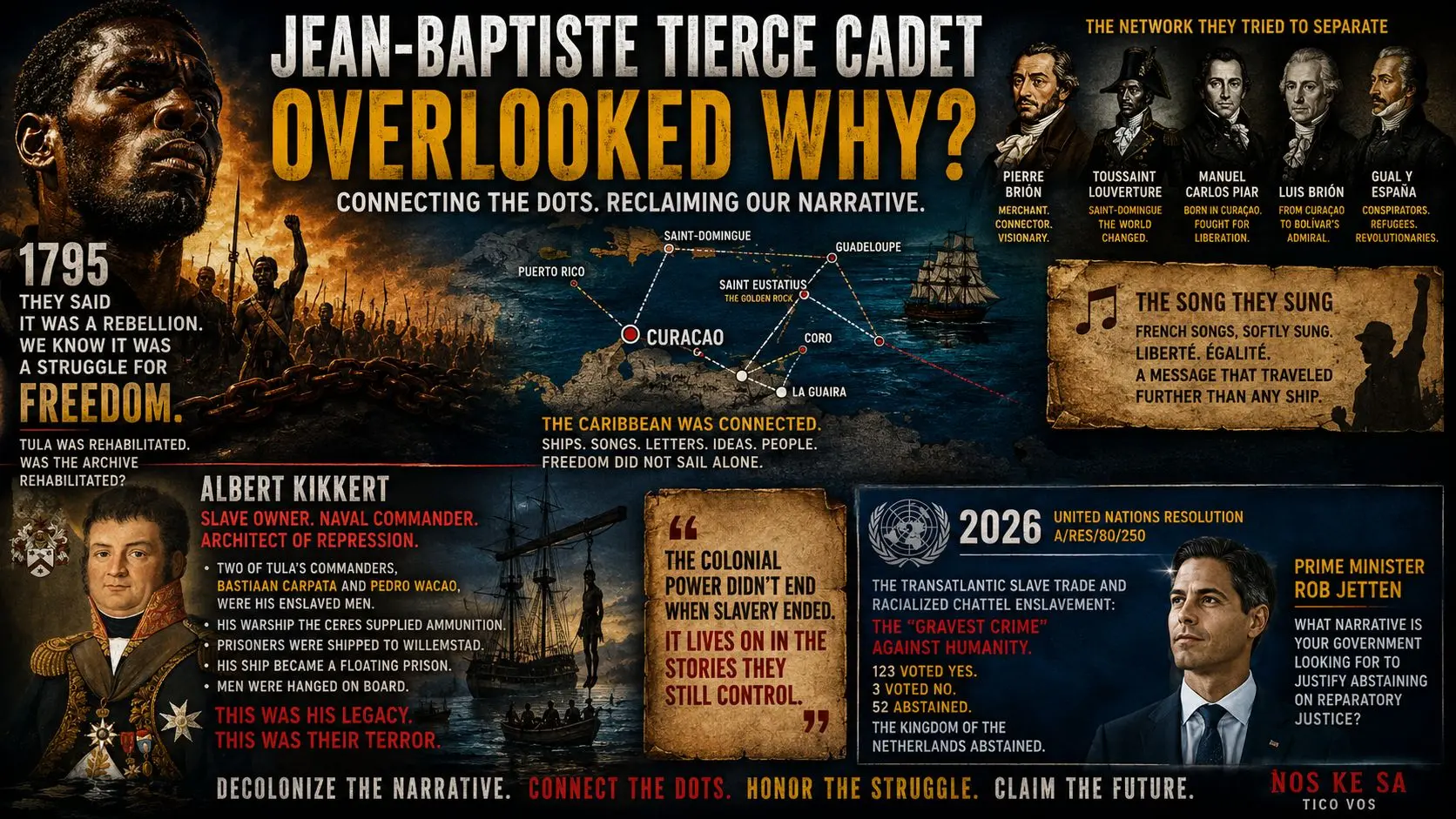
Sometimes history does not erase a person. It does something more effective. It separates him from everyone he knew, from the ships he followed, from the ports where he traded, from the commercial houses through which letters, information and money traveled, from the people who sat around the same tables discussing liberty, revolution, commerce and power. That may be what happened to Jean-Baptiste Tierce Cadet. His name appears beside Pierre Brión.
Then we encounter him in the political world connecting Curaçao with Guadeloupe and Saint-Domingue. His correspondence leads toward Victor Hugues, Sonthonax, Philippe Roume, and Toussaint Louverture. He appears in the environment surrounding Manuel Gual and José María España, revolutionaries hunted by the Spanish authorities who found refuge on Curaçao. Roberto Palacios brings Tierce into the environment in which we must also examine Manuel Carlos Piar. Rudy Riedel describes Tierce as a trusted man of Pierre Brión and a collaborator in the Brión family company. He also presents him as a contact with Haiti and as someone who may have influenced the young Luis Brión and his brother Theodore.
Then we arrive at 1795, and suddenly history breaks these connections apart. Tula and the enslaved are grouped in a single chapter. The Orangists in another. Patriots and French sympathizers somewhere else. Merchants get their own economic history.
Gual and España become Venezuelan history. Piar becomes a Venezuelan general. Brión becomes Bolívar’s admiral. Saint-Domingue becomes the Haitian Revolution. Guadeloupe becomes French colonial history. Saint Eustatius, the Golden Rock, is remembered for its role in supplying the American Revolution. But the ships did not know these chapters. The sailors did not travel through history books. And the songs did not carry passports. Perhaps historians separated people whom the Caribbean itself had connected.
In 2023, the Dutch government acknowledged the justice of Tula’s struggle and that of others who resisted slavery. Read the meaning of that carefully. The justice of Tula’s struggle. For more than two centuries, colonial language had placed Tula inside another vocabulary: slave, rebel, insurgent, disturber of order, danger.
But who created those definitions? The same colonial system that held human beings as property investigated their resistance. It selected the questions. It arrested the freedom fighters. It interrogated them. It tortured them. It prosecuted them. It executed them. And then that same institution preserved much of the paperwork that later generations used to reconstruct what happened. The institution that crushed the freedom struggle also became its principal archivist.
If Tula’s struggle was just in 1795, what exactly was false, distorted, incomplete, or deliberately framed in the narrative used to condemn him? And how much of that narrative still structures the history we repeat today? Tula was rehabilitated. Was the archive rehabilitated? Or did we simply replace the word rebel with freedom fighter while continuing to examine his movement through the compartments, terminology and assumptions created by the people who crushed it?
It sounds almost too simple to ask who the bad guys were. But perhaps we have avoided precisely this question because it forces us to turn the telescope around. For generations the story of 1795 was structured around the restoration of “order.” There was an uprising. The government responded. The military intervened. The revolt was suppressed. The leaders were punished. Order returned. But whose order? The order that allowed one human being legally to own another? The order that permitted people to be bought, sold, inherited and physically punished? The order under which refusing forced labor could become insurrection? The order in which demanding freedom became a security threat? Once the Netherlands acknowledges that Tula’s struggle was just, we must also reconsider the moral vocabulary traditionally applied to the men who fought to prevent that freedom.
That brings us directly to Albert Kikkert. Kikkert was not merely an uninvolved naval officer who suddenly received orders to restore peace. He belonged to the slaveholding colonial world. He had plantation interests. He was a naval commander.
Research into the military suppression of 1795 places him directly inside the machinery deployed against the freedom fighters. Bastiaan Carpata and Pedro Wacao were connected to Kikkert’s enslaved workforce and became important participants in the freedom struggle. Think about what that means. The colonial legal system told Kikkert that these human beings belonged to him. Then they stood up. They rejected that definition. They joined the struggle. They became freedom fighters. Colonial property had transformed itself into political resistance.
We must remain disciplined as researchers. We do not possess a document in which Kikkert tells us exactly what emotions this produced in him. We cannot manufacture his anger or motives. But we can reconstruct interests. Kikkert was a slaveholder. His authority was challenged. Human beings whom the colonial system regarded as property rejected that status. Men connected with his enslaved workforce joined the freedom movement. Kikkert then became part of the naval and military apparatus mobilized against that movement. That is not a footnote. That is property, power and freedom colliding inside one man’s world.
The Ceres, commanded by Kikkert, became part of the military operation. Prisoners were transported toward Willemstad. When detention capacity became insufficient, ships were incorporated into the imprisonment system. Naval records and subsequent historical reconstruction also confront us with something far more disturbing: captured Black men being hanged aboard vessels and bodies displayed as ships entered the harbor. For years we can hide this behind administrative language: prisoners were transported. No. Decolonize the sentence. Human beings fighting against enslavement were captured by the military force defending the slaveholding order. Some were executed. Bodies became warnings.
Now imagine Willemstad. Imagine standing near the harbor. Imagine being Black. Imagine being enslaved. Imagine knowing somebody who had disappeared into Tula’s movement. A ship enters the harbor. A Black body hangs from it. What message does that send? No proclamation is necessary. The body speaks. This is what happens when you claim freedom.
And therefore we must ask another uncomfortable question. Why such violence? Why was military defeat not enough? Why torture? Why exemplary executions? Why mutilate and destroy the bodies of leaders? Why make punishment visible? Perhaps because the colonial authorities understood something later narratives reduced. These people had not merely refused to work. They had begun imagining themselves as free human beings. They organized. They had leaders and commanders.
They negotiated. They moved across plantations. They possessed information about the outside world. They knew that enormous political changes were taking place elsewhere. They knew that Black people in the French revolutionary world had obtained freedom. French was spoken. French revolutionary influence circulated. Songs circulated. Names such as Rigaud and Toussaint entered this Caribbean political environment. Curaçao itself was divided among Orangists, Patriots, French sympathizers, merchants protecting their interests, military officials, and people watching revolutionary developments across the sea.
So perhaps the authorities were not simply frightened by a large group of enslaved people refusing forced labor. Perhaps they feared connection.
Open the map. Curaçao. Coro. La Guaira. Puerto Cabello. Puerto Rico. Saint Thomas. Saint Eustatius. Guadeloupe. Saint-Domingue. The United States. Ships were constantly moving between these worlds. And ships carried much more than cargo. They carried sailors, letters, newspapers, political refugees, weapons, money, stories, rumors, languages, songs and ideas. Saint Eustatius became the Golden Rock, one of the great commercial junctions of the revolutionary Atlantic. Guadeloupe became a center of French revolutionary activity and privateering. Saint-Domingue demonstrated something terrifying to every slaveholding society in the Caribbean: enslaved Black people could organize, fight, defeat armies and destroy the political certainty of slavery. And Curaçao stood inside those maritime routes, not outside history, but inside it.
Then Jean-Baptiste Tierce Cadet appears again. Tierce is uncomfortable. Perhaps that is exactly why he matters. He does not fit neatly inside our desire for pure heroes and pure villains. Archival research places Tierce near accusations of a conspiracy connected with Saint-Domingue, Curaçao’s government, and the liberation of enslaved people. He and others were eventually deported without trial. Yet the evidence for the enormous conspiracy attributed to him remains problematic. Tierce himself also belonged to a commercial world connected with slavery. Good. Do not remove the contradiction. Investigate it. Because the revolutionary Caribbean was full of contradictions. Men proclaimed liberty while owning human beings. Merchants demanded freedom of commerce while accepting slavery. Republicans demanded equality while fearing Black political power. European revolutionaries could demand freedom from kings while refusing to imagine Africans possessing exactly the same freedom.
Tierce may have stood directly on that fault line. Through Tierce we encounter Pierre Brión. Through Pierre Brión we encounter commercial connections with La Guaira. Through those commercial and political routes we encounter Gual and España. Through Roberto Palacios's research, we move toward the environment surrounding Piar. Through Rudy Riedel’s work we encounter the proposition that Tierce influenced the intellectual development of the young Luis Brión. And later, Manuel Carlos Piar and Luis Brión, two Curaçao-born men, become indispensable actors in Venezuela's liberation struggle.
Does this prove the existence of one secret organization spanning twenty years? No. Does it prove that Tula, Tierce, Piar and Brión belonged to one conspiracy? No. We should never manufacture evidence merely because the connections are attractive. But does it justify investigating a Caribbean revolutionary ecosystem? Absolutely.
Here we reach the deeper problem. Colonialism did not survive only through guns, forts, ships and chains. It survived through something equally powerful: the authority to define. Define who is civilized. Define who is property. Define who is dangerous. Define what constitutes order. Define what constitutes rebellion. Define whose violence is legitimate. Define whose testimony is believable. Define who deserves punishment. Define what enters the official record. Define what disappears. The colonial administration defined Tula as a threat to order. Then it investigated him through that definition. Then it punished him according to that definition. Then it preserved the documentation. Later historians inherited those documents. And eventually society inherited the historians.
That is how a colonial narrative can survive the empire that produced it. The flag changes. Slavery disappears legally. Governments apologize. A King asks forgiveness. Tula is rehabilitated. But one inherited habit can survive: power still wants to define the language before accepting the consequences.
And suddenly our investigation no longer stops in 1795.
On 25 March 2026, the United Nations General Assembly adopted Resolution A/RES/80/250 concerning the transatlantic trafficking of enslaved Africans, racialized chattel enslavement and reparatory justice. The resolution received 123 votes in favor, 3 against, and 52 abstentions. The Kingdom of the Netherlands abstained. Today Rob Jetten leads the Dutch government. So I ask a legitimate question, respectfully but directly: Prime Minister Rob Jetten, what narrative is your government constructing to explain that abstention?
The Netherlands apologized for its role in slavery. The King asked forgiveness. The Dutch government rehabilitated Tula. The Netherlands acknowledged the justice of the struggle against slavery. Then an international discussion moves from remembrance toward reparatory justice, and the Kingdom abstains. Why?
The European explanation deserves to be read seriously. It recognized slavery and the transatlantic slave trade as an unparalleled tragedy with enduring consequences. But objections were raised to describing one crime against humanity as the “gravest,” to aspects of the historical interpretation in the resolution and to the legal implications of reparations, including questions surrounding the retroactive application of contemporary international law. Those arguments deserve examination. But history gives us the right to ask something more: when does complexity help us understand justice, and when does complexity become a mechanism for postponing it?
That question matters because we have seen administrative language perform this function before. In 1795, the colonial government did not begin with the moral question: are these human beings entitled to freedom? The administrative questions became: how do we restore order? How many soldiers are required? Where is the ammunition? Where do we hold the prisoners? Who must be interrogated? Who must be prosecuted? Who must be executed? The fundamental moral question disappeared behind the machinery of administration.
Today nobody seriously needs to ask whether slavery was wrong. That question has been answered. The question now becomes: what does acknowledgment require? Can a state apologize for slavery, recognize the justice of resistance, rehabilitate a freedom fighter, and then become hesitant when remembrance develops into a demand for reparatory justice? That is a question worth asking. Not because 1795 and 2026 are identical. They are not. But because control over language remains control over consequences.
Perhaps the inherited colonial attitude was never only: we have the right to rule you. It was also: we have the right to define what happened to you. And eventually: we have the right to determine which consequences of that history are reasonable. That is why decolonizing our narratives matters. Not to fabricate history. Not to transform Tierce Cadet into a hero he may never have been. Not to invent secret meetings between Tula, Piar and Brión. Not to force every unexplained name into one enormous conspiracy. Quite the opposite. We must become more rigorous.
We must ask questions the colonial archive was never designed to answer. Who travelled? Who spoke French? Who carried letters? Who knew what had happened in Saint-Domingue? Who traveled through Guadeloupe? Who moved between Curaçao and Coro?
Who knew the songs? What were those songs? Why were their titles not recorded? Who taught them? Where else were they sung? Did versions travel through Puerto Rico, Venezuela, Guadeloupe, or Saint-Domingue? Who supplied the freedom fighters? Which sailors communicated with free Black French citizens?
Which commercial networks later protected political refugees such as Gual and España? Why does Tierce Cadet repeatedly appear near these networks? What did the young Piar hear? What did the young Brión see? What conversations took place around commercial houses, wharves, ships and dinner tables? And what did enslaved people themselves know that the men writing the colonial reports never bothered to record?
Perhaps we have studied Tula too much as an isolated man. Piaroa too much as a Venezuelan general. Brión too much as Bolívar’s admiral. Gual and España too much as Venezuelan conspirators. Tierce Cadet too little. And Curaçao too often as a small Dutch island standing at the edge of world events.
Turn the map around. Another Curaçao appears. A Curaçao positioned inside a revolutionary Caribbean conversation. The freedom fighters of 1795 did not need a university lecture explaining the French Revolution. A Black sailor arriving from a French Caribbean port could carry the lesson. A song could carry the message. A ship could carry a letter. A merchant could carry information. A commercial network could hide a political refugee. A harbor could become a newsroom. A tavern could become a political classroom. And a human being legally classified as the property of Albert Kikkert could reject that definition and become Commander Bastiaan Carpata.
There, standing before us, is the contradiction of the entire colonial narrative. The document says property. The human being says freedom. The government says rebel. History now says freedom fighter.
Tula was rehabilitated. Now return to Carpata. Return to Wacao. Return to Mercier. Return to the women and men whose names remain scattered through interrogation records. Return to the sailors. Return to the merchants. Return to the refugees. Return to the ships. Return to the songs. Return to Tierce Cadet. And, yes, return to Albert Kikkert. Because if we are prepared to investigate the freedom fighters, then intellectual honesty demands that we investigate with equal intensity the men who fought to prevent their freedom.
And when governments today present carefully constructed explanations for why they can apologize for slavery while abstaining when an international debate advances toward reparatory justice, we must continue asking questions. Not because history repeats itself in exactly the same form. It does not. But because the power to define the narrative remains power.
So our investigation can no longer stop with the familiar question: why did Tula rise on 17 August 1795? We need a bigger question: what Caribbean world taught Curaçao’s freedom fighters that another future was possible, and why have we been taught to study the people, ports, ships, songs and ideas of that world separately?
Perhaps the dots were always there. Jean-Baptiste Tierce Cadet is one of them. The archive is still there. The ships are still in the journals. The names are still buried in the interrogations. And somewhere inside this history, the unnamed songs are still waiting for us.
This time, we will not read only 1795 from the deck of the officer who wrote the report. We will try to read it from the plantation, from the road to Porto Marie, from the prison, from the harbor, from the ship, from the perspective of the human being whom the archive called property, and even from the perspective of the Black human being whose dead body was displayed from a vessel as a warning to others who might dare to imagine freedom.
Who defined this story, and why did we believe it for so long?
Tico Vos | Nos Ke Sa