From Tula to Piar
Freedom Had to Become Equality
By Tico Vos | Nos Ke Sa
History often separates what time itself joined together. For generations, Curaçao has remembered Tula, Manuel Carlos Piar and Luis Brion as separate historical figures. Tula is part of the history of slavery and 1795. Piar belongs to Venezuela and the wars of independence. Brion belongs to Bolívar and the republican navy. But perhaps these are not three separate stories. Perhaps they are three chapters of one larger Curaçaoan contribution to the Atlantic Age of Freedom.
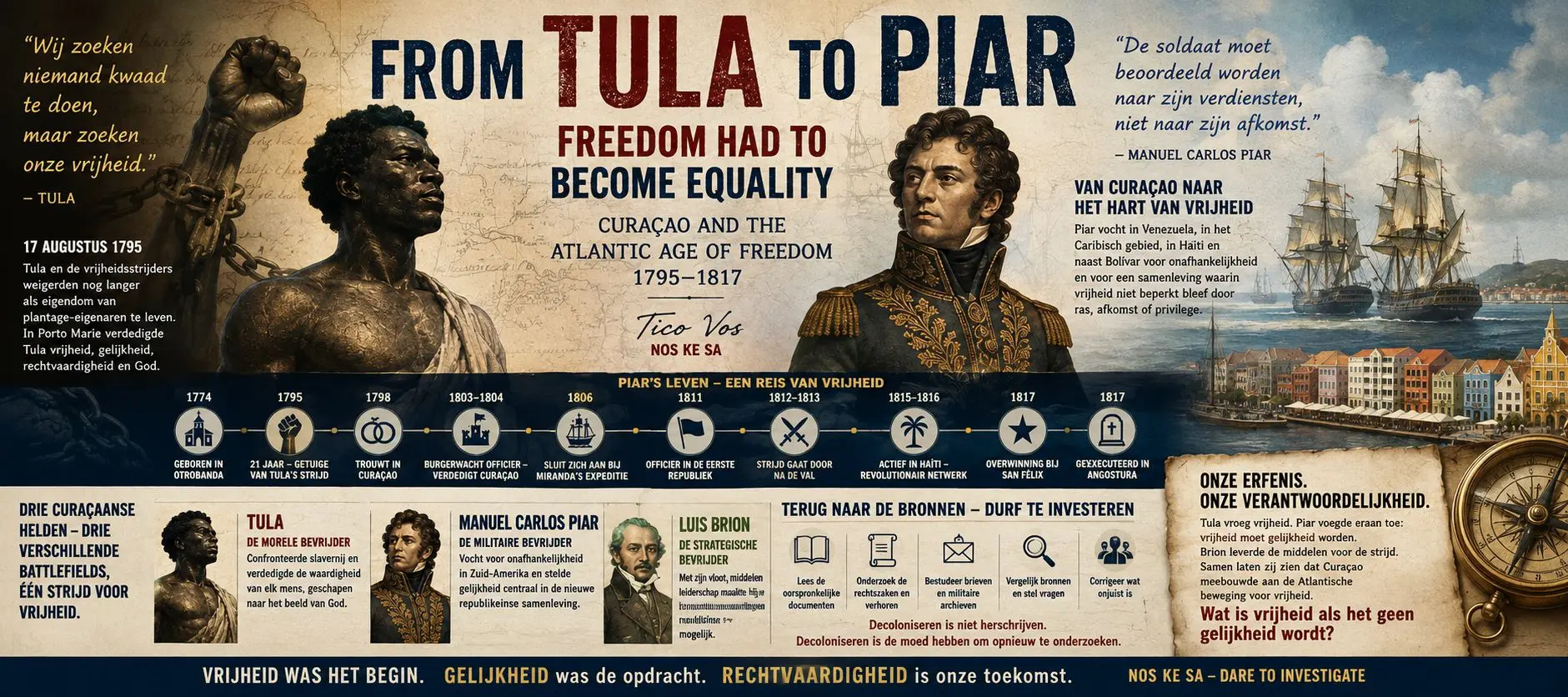
When Tula stood before Father Jacobus Schinck at Porto Marie in August 1795 and explained why freedom had to be regained, Manuel Carlos Piar was twenty-one years old. Born in Otrobanda and baptized at Santa Ana on 28 April 1774, Piar was living on Curaçao during the island’s greatest confrontation with slavery and colonial authority. History does not allow us to claim that he stood beside Tula, but neither should we write his biography as if 1795 happened somewhere far away. He belonged to the same generation and lived through the same defining moment.
That Curaçao was shaken by military mobilization, fear among plantation owners, arrests, torture, executions, and a fundamental question: can one human being justly own another? Tula’s answer was clear. According to Schinck’s report, he did not merely complain about difficult conditions. He built a case based on mistreatment, freedom, international political change, shared humanity, and God. His reference to Adam and Eve was not a decorative religious argument. It went to the heart of equality. If all human beings descend from the same first parents, what moral basis can justify one group owning another?
Now place twenty-one-year-old Piar inside that society. What did he hear? What did he see? What conversations took place in Otrobanda? How did free Black and mixed-race Curaçaoans respond? How did merchants, soldiers, and clergy respond? We do not yet have all those answers, but these are precisely the questions historians should be asking.
Three years later, in 1798, Piar married María Martha Boom in Curaçao. Soon afterward, his life began moving through the same Atlantic world in which freedom struggles were spreading from colony to colony. He became involved in the revolutionary movement associated with Francisco de Miranda, later fought in Venezuela, continued the struggle after the collapse of the First Republic, operated in the Caribbean, became active in Haiti, and eventually joined Bolívar’s renewed campaign. By 1817, at San Félix, Piar had become one of the most important military commanders of the independence movement.
His own life also exposed the contradiction of colonial racial classification. Although described as fair-skinned, blond-haired, and blue-eyed, his mother, María Isabel Gómez, was classified within the colonial hierarchy as a free woman of mixed ancestry. In such a society, appearance alone did not determine status. Ancestry, birth and legal classification mattered. Those categories influenced opportunity, rank, prestige and access to power. Piar grew up inside that system.
This is where the bridge with Tula becomes clearer. Tula challenged slavery itself. Piar confronted the unfinished inequality that could remain after independence. What kind of republic would emerge if Spain disappeared but racial hierarchy survived? What would freedom mean if pardos, Black people, Indigenous people and the poor remained excluded from power? What would independence mean if the plantation elite still depended on enslaved labor?
His opponents accused him of promoting pardocracia. That accusation must be examined critically, not simply repeated. Who made it? Why? In what political context? Who benefited from portraying Piar as a threat? Was he seeking domination by one racial group, or broader equality in a society where inherited privilege remained deeply rooted? These questions belong at the center of any serious reassessment of his life.
For me, this is the essential bridge. Tula fought to regain freedom. Piar confronted the question of what freedom must become. Independence without equality is unfinished freedom. Freedom had to enter the law, the army, citizenship, political power and social opportunity. Otherwise one ruling order could simply be replaced by another.
Luis Brion adds a third dimension. He brought ships, resources, naval leadership and strategic support. So within one remarkable generation, Curaçao produced Tula, confronting slavery and defending human freedom; Piar, carrying the struggle across the Caribbean and northern South America while confronting racial and social inequality; and Brion, helping provide the means to sustain liberation.
Remarkably, this connection was already recognized in August 1995. BEURS Magazine published a special edition placing Tula and Piar together under the title “Tula en Piar, Helden van Curaçao.” Inside were articles on the 1795 uprising, Father Schinck’s encounter with Tula, the punishment of the freedom fighters, the question “Wie was Tula?”, and Manuel Carlos Piar as a defender of freedom. More than thirty years later, that editorial choice deserves renewed attention. They had already placed the two men in the same historical conversation.
Our responsibility now is to go deeper. We have inherited important historical works by Johan Hartog, Pater Brada, Mario Kleinmoedig, Tino Martina and others. Their work deserves to be read and respected. But no later historian should become more important than the original source. Every interpretation was written in a particular period and from a particular perspective.
So we must return to Schinck’s report, to the interrogations, the court documents, baptismal registers, military correspondence, letters and archives in Curaçao, Venezuela, Haiti, the Netherlands, Spain and elsewhere. Not because we want to invent a new past, but because Curaçao deserves a history that can survive investigation.
Perhaps decolonizing history does not mean replacing one predetermined narrative with another. Perhaps it means having the courage to investigate again, question inherited assumptions, compare sources, identify contradictions, and correct what the evidence proves to be wrong.
Tula deserves that. Piar deserves that. Brion deserves that. Curaçao deserves that.
Perhaps these were never three unrelated stories. Perhaps together they reveal something much larger: Curaçao was not merely watching the Atlantic Age of Freedom. Curaçao was participating in it. Tula demanded that stolen freedom be regained. Piar confronted the reality that independence without equality remained incomplete. Brion helped provide the means to carry liberation across the sea.
And the question they leave us remains powerful today:
What is freedom if it does not become equality?